
Reports

_page-0001.jpg)
Climate, Peace and Security in Stabilization Contexts in the Sahel: Summary from Regional Experts Workshop
This report summarizes key insights from the Regional Experts Workshop in La Somone, Senegal, and the High-Level Partnerships Forum in New York, USA, held in March and April 2024. Convened by UNDP in collaboration with regional partners, including the Lake Chad Basin Commission and African Union Commission, these events brought together over 250 stakeholders to explore how climate, peace and security solutions can enhance stabilization efforts in the Sahel.
Addressing the region’s interconnected challenges of climate change, conflict and insecurity, the discussions highlighted innovative approaches including integration of solar energy, strengthening local governance, and blended climate finance to build resilient communities. The report outlines actionable recommendations for aligning climate and stabilization programming, emphasizing regional cooperation, community ownership and sustainable development. It underscores the urgency of addressing climate-related security risks to ensure lasting peace and resilience in the Sahel.
Download.jpg)
Beyond vulnerability: A guidance note on youth, climate, peace and security
Around 47% of youth aged 18–29 live in countries with extreme or high levels of conflict, 250 million of who live in least developed countries (LDCs), where climate change hits hardest, especially in the Sahel, Horn of Africa, and Central Africa. These areas face overlapping challenges of climate hazards, insecurity, and youth vulnerability. This Guidance Note aims to bridge the Climate, Peace, and Security (CPS) and Youth, Peace, and Security (YPS) agendas. It highlights youth-led efforts to address climate-related security risks in these regions,providing practical guidance for advancing a unified agenda on youth, climate, peace, and security, emphasizing the importance of recognizing and supporting youth’s transformative role.
Download.jpg)
Gender, Climate and Security: Sustaining inclusive peace on the frontlines of climate change
Climate change is a defining threat to peace and security in the 21st century – its impacts are felt by everyone, but not equally. Gender norms and power dynamics shape how women and men of different backgrounds experience or contribute to insecurity in a changing climate. Grounded in a series of case studies from research and programming experience, this report offers a comprehensive framework for understanding how gender, climate and security are inextricably linked. The report assesses entry points for integrated action across existing global agendas and suggests concrete recommendations for how policymakers, development practitioners and donors can advance three inter-related goals: peace and security, climate action and gender equality..
Download.jpg)
Re-envisioning Climate Change Adaptation Policy to Sustain Peace - A Typology and Analysis of the National Adaptation Plans
This study maps the extent to which climate, peace and security intersections are addressed in the National Adaptation Plans (NAPs) and offers a blueprint for the mainstreaming of climate-related security risks into the NAPs and for synergies between adaptation policies and peacebuilding efforts.
Download
Climate Finance for Sustaining Peace: Making climate finance work for conflict-affected and fragile contexts
This study assesses trends in access to climate finance in conflict-affected and fragile contexts; gaps and opportunities to leverage the co-benefits of climate action for peace and security; strategies for mainstreaming climate-related security risks into climate finance; and recommendations to make climate finance work more effectively in contexts affected by conflict and fragility. A metadata analysis of 955 projects (US$ 14.4 billion) implemented in 146 countries, including 56 fragile states, shows that conflict and fragility may affect access to and implementation of climate finance and, how its implementation may interact with drivers of fragility and insecurity. Qualifying co-benefits or peace dividends may help incentivize much-needed investments, but Theories of Change also need to be reconstructed.
Download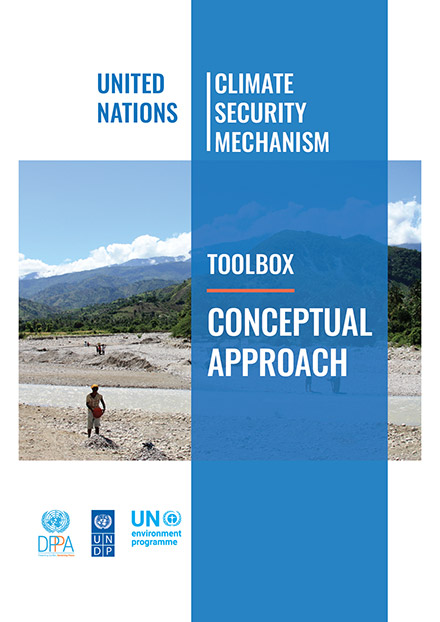
Climate Security Mechanism Toolbox: Conceptual Approach
This note presents a conceptual approach to understanding the interconnections between climate change, peace, and security within the UN system. Complementing existing analytical frameworks, it emphasizes the assessment of how climate change interacts with socio-political, economic, and demographic factors, potentially causing disruptions, instability, and insecurity across various scales. The approach advocates for coordinated, cross-sectoral efforts to address climate-related security risks and supports decision-making processes such as Common Country Analyses and strategic assessments. Designed to be flexible and adaptable, it is not a substitute for comprehensive climate vulnerability assessments.
Download