
Policy Briefs

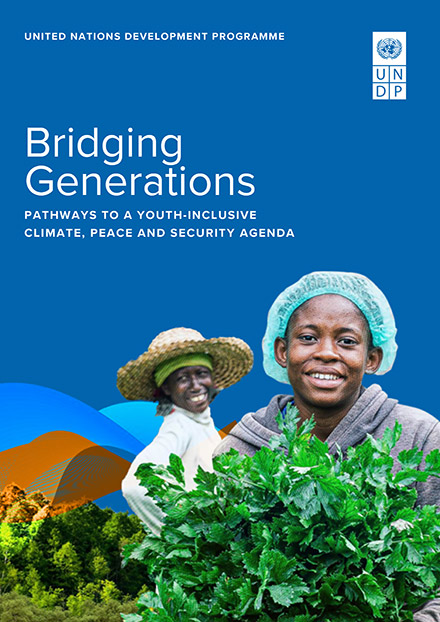
Bridging Generations - Pathways to a Youth-Inclusive Climate, Peace and Security Agenda
Over 698 million young people, ages 15-35, live in fragile and conflict-affected settings. These settings are highly affected by climate change. Young people find themselves in unique positions – they are the most vulnerable to climate, conflict and insecurity, yet they also hold the key as critical actors who can drive change. This policy paper explores early findings from how UNDP’s Climate, Peace, and Security (CPS) policy and programming engages youth, fosters inclusion, and promotes youth empowerment. The paper examines potential gaps, challenges, and opportunities, offering early recommendations for improving the integration of youth-sensitive, responsive, and inclusive approaches to CPS.
Download
Guidance Note - Climate, Peace and Security in Latin America and the Caribbean
While climate change impacts ecosystems, societies, institutions, and infrastructure, it also compounds structural weaknesses, has a differentiated impact, and hits hardest where coping capacities are already compromised. For example, 12 of the 20 countries most vulnerable and least prepared to adapt were in conflict in 2020, with countries affected by violence receiving less climate finance, on average. As the pace of climate change accelerates, so does its impact on peace and security. Yet, the global evidence base on climate-related security risks remains limited, as do examples of initiatives at scale. This policy note takes a pragmatic approach to describing how UNDP might engage with climate, peace and security in Latin America and the Caribbean (LAC) and identify possible points of entry.
Download
Reviewing climate-related human mobility in Latin American and Caribbean’s Nationally Determined Contributions (NDCs) and National Action Plans (NAPs)
The inclusion of human mobility priorities in Nationally Determined Contributions (NDCs) and National Action Plans (NAPs) can potentially improve adaptation, resilience and measures to address climate-induced loss and damage. This assessment reviews the extent to which human mobility features in NDCs and NAPs in Latin America and the Caribbean (LAC). It finds that not only does the region feature more NDCs and NAPs than other parts of the globe, but they generally reveal a higher engagement with categories such as displacement, migration and relocation.
Download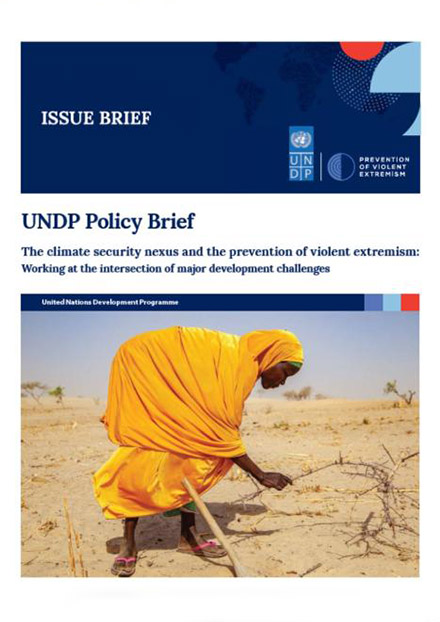
The climate security nexus and the prevention of violent extremism: Working at the intersection of major development challenges
This policy brief explores initial lessons learnt from a climate security perspective of efforts to prevent violent extremism in politically and environmentally fragile contexts affected by climate change. It draws on recent country level examples, preliminary insights from UNDP’s work streams on climate security and the prevention of violent extremism (PVE), as well as an online experts’ consultation held on 2 June 2020. It identifies the need for policy and programming to be informed by cross-cutting climate-related security risks and stresses the importance of further research and examination of good practices to address such risks.
Download
Toward new policies for the climate change and violent extremism nexus in Africa
The policy brief draws upon interviews and literature regarding climate security, violent extremism, and intrastate conflict in relation to evidence from cases in the Central Sahel, the Lake Chad Basin, Mozambique, and Somalia. It concludes that to the extent that grievances caused by climate change influence violent extremism, they are best assessed within a contextualized analytical framework that also incorporates the impact of climate change on the viability of violent extremist groups, and improvements can be made in taking an integrated approach to conflict analyses, policymaking, and programming. Finally, the policy brief offers ten recommendations to national governments and development actors, PVE practitioners, military and security forces, UN peace operations, and researchers to better inform project and policy design and implementation.
Download
Guidebook on Addressing Climate, Peace and Security Programming in UN Peace Operations in Africa
Launched on the occasion of The International Day of United Nations Peacekeepers, the guidebook “Addressing Climate, Peace and Security Programming in UN Peace Operations in Africa”, this guidebook aims to fill a gap in the programming of UN Peacekeeping and Special Political Missions, by helping practitioners better understand how climate change risks interact with peace and security. It provides information for peace operations on integrating climate and conflict risk analysis and planning, as appropriate, as well as supporting impactful implementation of their mandates. Moving forward, personnel of UN Peacekeeping and Special Political Missions should have better tools and training to support national governments, to integrate an environmental and climate lens into analysis, planning, operations, programming and performance assessments.
Download
Nature For Peace: Nature Pledge - Nature For Development Action Kits
Nature underpins our lives, societies, and economies and is fundamental to achieving our 2030 Agenda. Addressing the nature crisis is essential to eradicating and preventing poverty, reducing inequalities, and protecting human rights.
This publication offers entry points to advance peacebuilding through nature-based solutions. It will help decision-makers and practitioners recognize programming options and make the case for investing in nature to achieve development outcomes.
Download
Knowledge Gaps In The Nexus Of Climate, Peace And Security
The literature on how to integrate climate adaptation and mitigation actions in efforts to build sustainable peace is still underdeveloped. However, there are related fields, such as the relationship between peace, conflict and natural resource management that may offer comparable lessons. This policy paper takes stock of the existing knowledge and identifies knowledge gaps for policy practice in the crucial, complex and emergent field of climate, peace and security. It classifies significant gaps in our actionable knowledge by sorting them into operational knowledge gaps, climate finance knowledge gaps, and gaps in the knowledge infrastructure.
Download